How Cold Days Can Affect Your Luxury Watch
Cold weather challenges luxury watches, affecting accuracy, lubrication, and seals, revealing how well your timepiece is cared for.

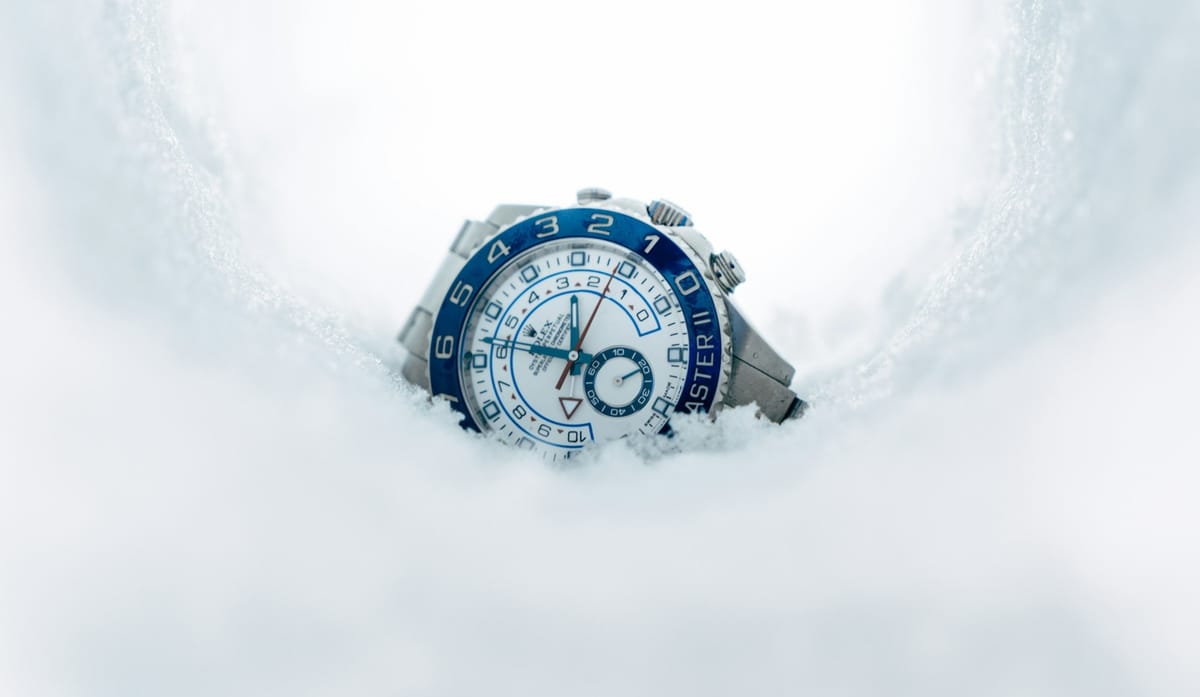
Cold weather has a way of revealing what a watch is truly made of. Slip a Royal Oak beneath a wool sleeve or snap a Submariner over a ski glove, and you’re asking the movement, the seals, the lubricants, and even the strap to perform in conditions far from the climate-controlled rooms where they were regulated.
Luxury watches are engineered to handle real life. But winter, true winter, throws curveballs that even high horology must negotiate.
Inside the Movement
Mechanical watches depend on predictable physics. Winter complicates that.
Metal Contraction
The architecture of a movement shrinks microscopically as temperatures drop. Balance amplitudes dip. Hairsprings breathe a little differently. Accuracy can drift by a few seconds a day, just enough for attentive collectors to notice.
Thickening Lubricants
Cold weather doesn’t freeze lubricants, but it does thicken them. This reduces efficiency throughout the gear train, shortens effective power reserve, and makes date changes or calendar jumps feel less assertive. A well-serviced Patek or Omega will handle this gracefully; an overdue watch will not.
Complications Under Pressure
Chronographs stiffen. Perpetual calendars become more reluctant to advance. Anything that relies on levers and springs becomes overtly aware of the cold.
Think of it this way: winter doesn’t damage complications; it exposes the ones craving a watchmaker’s attention.
Quartz Watches
High-end quartz movements (think Grand Seiko 9F or Omega thermo-compensated calibres) fare better in cold, but not perfectly.
- Crystal oscillators drift slightly at low temperatures.
- Batteries deliver lower voltage in the cold, especially outdoors.
- LCDs, on ana-digital luxury pieces, can briefly “ghost.”
Quartz resists winter better than mechanical, but it isn’t immune.
The Silent Threat
The greatest winter risk isn’t accuracy, it’s condensation.
Gasket Behavior
Gaskets and seals become stiffer in the cold. Cases contract. A watch that is water-resistant in a boutique may be less so after an afternoon at −5°C.
Fog Under the Crystal
Bring a cold watch into a warm, humid room, and you may see a soft mist bloom beneath the sapphire. That’s moisture inside the case; not a cosmetic issue, but a mechanical emergency. If it appears even once, the watch needs immediate attention.
Materials & Straps
Steel, Titanium & Gold
Structurally unfazed by cold, though they feel sharper and slightly tighter on the wrist.
Ceramic
Winter doesn’t weaken ceramic, but sudden knocks, more common with gloves and gear, become its Achilles’ heel.
Leather & Rubber Straps
Leather stiffens and can crack if flexed aggressively in low temperatures. Rubber becomes firmer. A bracelet is the most winter-ready option, and micro-adjustments suddenly feel indispensable.
Real-World Winter Scenarios
Skiing & Snowboarding
A diver or sports watch under a jacket is typically safe. The concerns: impact, snow intrusion around the crown, and drastic hot-cold swings between lodge and slope.
Cold-Water Diving
A Seamaster or Fifty Fathoms is up for the challenge; if its seals are fresh and pressure-tested. Old gaskets and icy water are a famous recipe for disaster.
Daily Wear
The biggest danger isn’t the outdoors; it’s transitioning from cold street to warm indoors. That’s where condensation and timing swings happen.
Winter Best Practices
- Wear watches under a sleeve to moderate temperature.
- Avoid operating crowns or pushers when the watch is cold and damp.
- Allow time for acclimation when moving between environments.
- Store watches away from windows, drafts, and unheated spaces.
- Treat any internal condensation as urgent.
Cold weather doesn’t break a watch; it reveals its servicing needs.
Luxury watches are more winter-capable than most owners realise. They’ve been to polar expeditions and alpine summits long before they became lifestyle accessories. Yet winter remains the one season when the physics inside a movement step onto centre stage.
In cold weather, your watch becomes more honest, showing you what it’s made of, how well it’s been cared for, and whether it’s truly the thoroughbred timekeeper its brand promises.