The Art of Time Taken to Its Limits
Vacheron Constantin explores the limits of time through five extraordinary creations where complexity meets art and innovation.

At Watches and Wonders Geneva, where the language of watchmaking is often spoken through incremental innovation, Vacheron Constantin chooses a different tone entirely. It presents not just new timepieces, but a statement of intent. A reminder that the pursuit of time, in its most profound sense, is still an open journey.
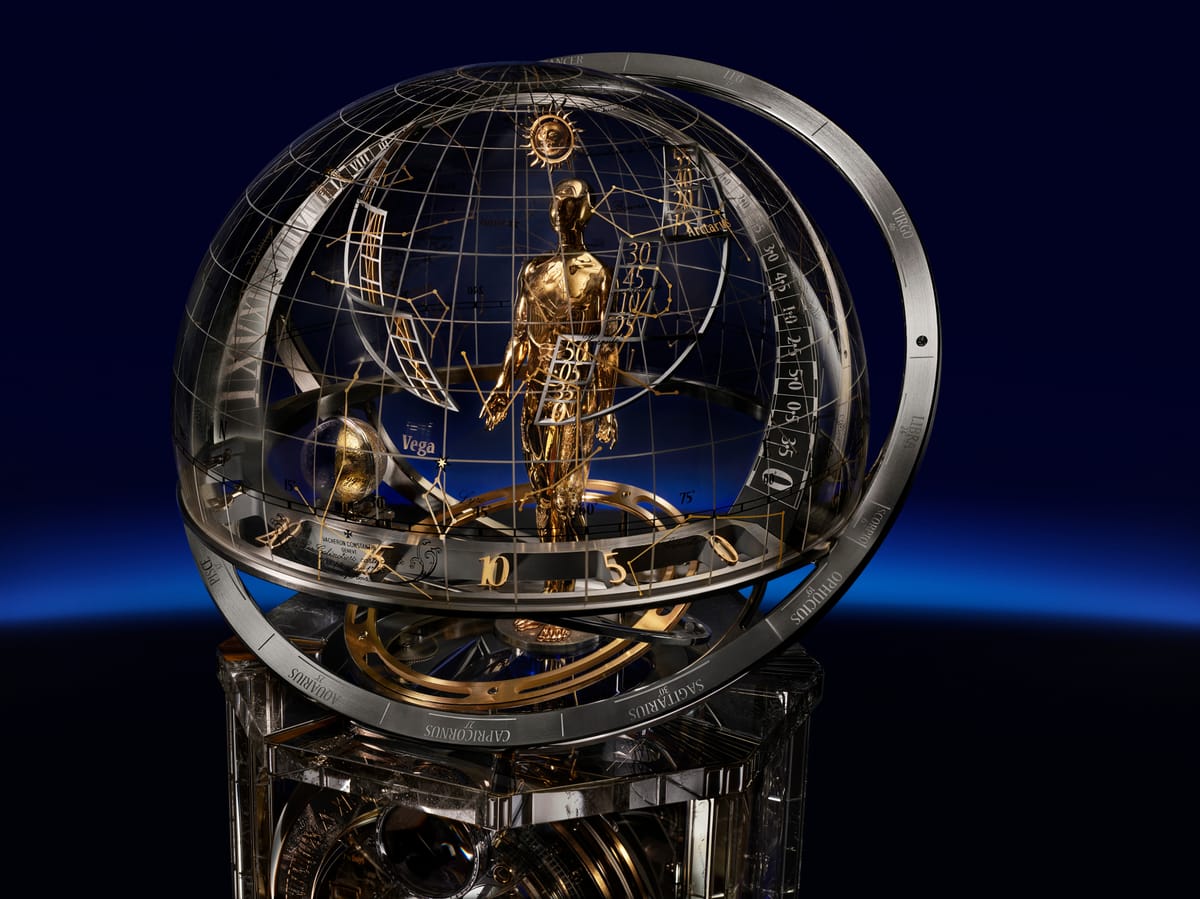
At the centre of this exhibition stands La Quête du Temps, an astronomical automaton clock that represents years of development and an extraordinary level of ambition. First revealed at the Louvre and now shown in Switzerland for the first time, it is less an object and more an experience. Combining mechanical complexity with artistic craftsmanship, it brings together timekeeping, music, and motion in a single, orchestrated creation.
What makes it particularly compelling is the way it approaches complexity. With thousands of components and dozens of complications, it could easily overwhelm. Instead, it feels composed, almost narrative in the way it unfolds. Time is not simply displayed, it is performed, measured not only in precision but in rhythm and movement.
This idea extends into the accompanying Métiers d’art piece, which translates the spirit of the clock into a wristwatch. Here, astronomical indications and retrograde displays are treated not as technical showcases, but as visual expressions of time’s cyclical nature. The result feels less like a reduction and more like a reinterpretation.
Surrounding these creations are three of the most ambitious horological works ever made. Each represents a different moment in the brand’s ongoing exploration of complexity.
Reference 57260 remains a landmark, not just for its record breaking number of complications, but for the way it integrates cultural and calendrical systems rarely seen in watchmaking. It expands the idea of what a watch can measure, moving beyond conventional time into something more universal.
The Berkley Grand Complication pushes this further, introducing an unprecedented level of intricacy while achieving a fully realised Chinese perpetual calendar. It reflects years of research and a willingness to engage with timekeeping traditions that extend far beyond Switzerland.
Then there is Solaria Ultra Grande Complication, a wristwatch that challenges the limits of what can be contained within wearable form. Its combination of astronomical functions introduces a new layer of depth, linking the measurement of time directly to the observation of the cosmos.
Taken together, these five creations form more than an exhibition. They create a dialogue between art and engineering, between history and possibility. They ask what it means to measure time when the tools themselves become expressions of human curiosity.
What emerges is not just a display of technical achievement, but a philosophy. One that sees time not as something to be controlled, but explored. In that sense, the exhibition feels less like a conclusion and more like a continuation of a centuries old pursuit.